SAMARAS of the FEMALE BOX ELDER (Acer negundo)
SAMARAS of the FEMALE BOX ELDER (Acer negundo)
By Alyce Santoro
This artwork and writing was originally published in the SeedBroadcast agri-Culture Journal #24
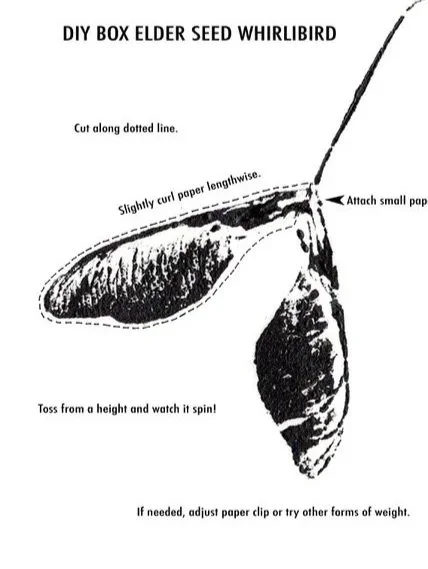
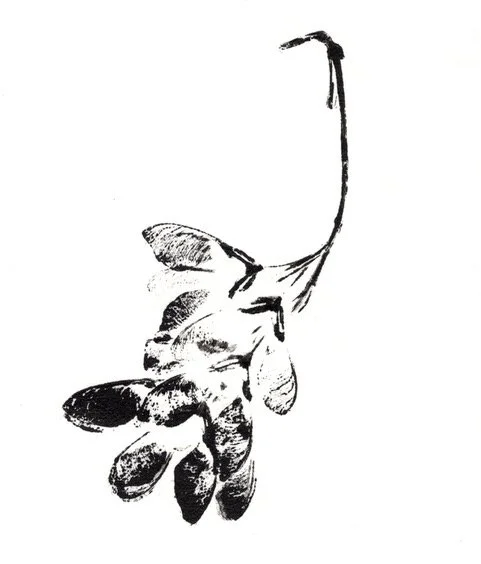
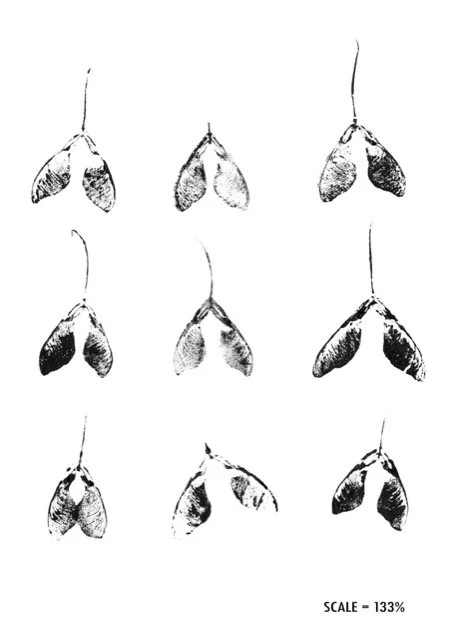
Alyce Santoro, Prints of Box Elder samaras collected in spring, ink on mulberry paper, 2025
The Box Elder is in the maple family, though its poison ivy-like groupings of three jagged leaflets are unique among maples. The trees are dioecious, or have two “genders”: pendulous flowers of the “male” make pollen, while the wind-pollenated flowers of the “female” become winged fruits called SAMARAS.
Upon release, the samaras’ asymmetrical wing-like shape, heavier at the pod end, creates both lift and vortex-like spin that can carry the flying seeds far from the parent tree. Because they are fun to play with, the seeds are known to children as whirlibirds, helicopters, or spinning jennies (after an apparatus used in textile manufacture).
The sap of the Box Elder, like other maples, can be tapped in spring and boiled down into a sweet syrup.
While the Box Elder is host to many beneficial butterflies and moths, it is also beloved by the Box Elder Bug (Boisea trivittata), a harmless but prolific red and black insect. As the weather cools in fall, massive groupings seek warm, sheltered places and are known to take refuge in the south-facing cracks of human dwellings situated near a host tree.
REFERENCES:
Southern Research Station USDA, Acer negundo L.: Boxelder, Ronald P. Overton
Biomechanics in the Wild, “Whirlybirds, Helicopters, and Maple Seeds,” University of Notre Dame, April 7, 2021
American Indian Magazine, “The Indigenous Origins of Maple Syrup,” Tony Tekaroniake Evans, Winter 2022, Vol. 23 No.4
NM State University, Box Elder Bugs, O&T Guide O-#04, Carol A. Sutherland, October 2006
Alyce Santoro is a sound and conceptual artist with a background in biology, scientific illustration, and the environmental humanities. She is co-proprietor of Third Ear Farm in Northern New Mexico.